Reading Aloud
Tired of Toy Lists? Let's Talk Books (and Giving Back!)
Are you as tired of those "Top Toys for 2025" lists as I am? Every child is unique, and what one kid loves, another might ignore. I've seen children adore a simple stick, and we all have those special rocks or trinkets our kids insist on keeping. We don't need Amazon to tell us what to buy.
However, I'm always open to book recommendations! Libraries are truly magical for toddlers and parents alike. You can choose what you want, return what you don't, and revisit favorites again and again. Plus, that receipt showing how much you've saved by using the library? Pure joy!
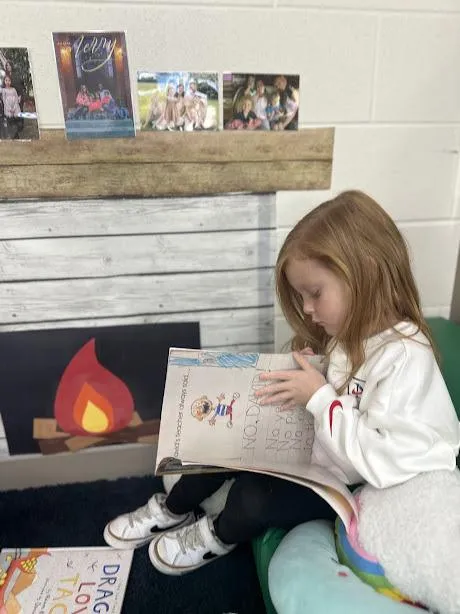
Last month, we talked about the benefits of talking aloud with your child, but reading together is truly the BEST activity you can do. Find a cozy spot, grab a blanket, and snuggle up with a good book or two. It's wonderful for their mind, your soul, and both your hearts.
Sharing the joy of reading helps children build their vocabulary—a crucial part of literacy. Vocabulary includes the words we understand when reading or listening, and the words we use when writing and speaking. Learning new words in the context of a book can spark your child's interest in understanding and using them.
Here are some fun ways to boost vocabulary as you read together (using examples from Giraffes Can’t Dance):
Preview the book: Before reading, look for new words your child might not know and plan to explain them.
Give a brief explanation: Use words your child already knows to define new ones. For example, "rooted" could mean "frozen in place, stuck."
Provide a synonym: Offer a similar word, like "unmoving" for "rooted."
Repeat the word: Say the new word (like "rooted") together.
Connect to their experience: Link the new word to something your child already knows. "Remember when I dropped my plate and was so surprised I didn't move? I was rooted in place for a moment."
Use objects, pictures, and movements: Point to illustrations, or act out the word (like dancing and then suddenly being rooted to the spot).
Read multiple times: Children love rereading, and explaining words during repeated readings helps them remember.
Use the word at other times: Incorporate the new word into everyday conversations. If you see a character "rooted to the spot" in another book or movie, point it out!
Reading together is a fantastic way to introduce new vocabulary and support literacy. Don't forget to check out our "most loved books" list, curated by our wonderful teachers at St. Francis.
Thankfulness at St. Francis
As we approach Thanksgiving, I also want to share how we're showing thankfulness at St. Francis Early Learning Academy. Our students are participating in a service-learning opportunity by collecting shelf-stable food for the St. Ann's Soup Kitchen. In October, we collected winter hats, gloves, coats, and outerwear for Lafayette Urban Ministry. Teaching children to help others in need is a core foundation at St. Francis, aligning with the main tenets of the Catholic church and introducing our students to corporal works of mercy.
Book Recommendations:
Miss Shawn: Silly Sally by Audrey Wood is one of my favorite books for young children because it is amusing to read, the illustrations are delightful, and the book teaches children about position words. When I read the book aloud to class the children like to act out Silly Sally walking backwards upside down. The children participate in reading the book by memorizing the words. This book gets read monthly as it is a class favorite.
Mrs. Van Kirk: One reason Oh, the Places You’ll Go! by Dr. Seuss is my favorite book to read to preschool children is that it teaches them—through fun rhymes and colorful illustrations—that life is full of adventure, choices, and possibilities. It helps them start to understand that even when things get tough, they have the courage and creativity to keep moving forward. It also helps them remember that, while preschool is the start of their learning journey, the big wide world with endless possibilities awaits them after they graduate from St. Francis. It’s only the beginning!
Mrs. Baldwin: One of my favorite books to read to the kids is Knight Owl by Christopher Denise. It's a charming story about a small bird with big dreams of becoming a fierce, brave, and honorable knight. The story teaches kids that size doesn't always matter. As long as you do your best and work hard, anything is possible. Not to mention the illustrations are AMAZING! The author recently released a sequel, Knight Owl and Early Bird, which is also a great and adorable story.
Mr. Jack: Jenny's Journey by Sheila White Samton is a simple narrative about a lonely city girl, Jenny, whose best friend, Maria, has moved away. Jenny draws an imaginary boat to visit Maria and takes a fantasy journey across the ocean, encountering sights like islands, sea creatures, a liner, and a storm, before finally "meeting" Maria at a pier. Jenny assures Maria the pretend trip foreshadows a real visit. The art is semi-realistic, simplistic, and uses color effectively, appealing to both children and adults. The theme addresses the powerlessness children feel when separated from loved ones. The book suggests coping strategies like drawing/writing or taking an imaginary trip, as Jenny does. I frequently used this book last year when three students moved away.
A second favorite is Little Red Cowboy Hat by Susan Lowell, a Southwest American retelling of Little Red Riding Hood. Little Red Cowboy Hat, named for her grandma's gift, bravely rides her pony across the desert to bring her sick grandmother bread and cactus jelly. She escapes an initial encounter with a wolf only to find him disguised as her grandma. The story follows the traditional plot until the wolf grabs Red; then Grandma intervenes, chasing the wolf out the window. The final scene emphasizes the lesson: "A girl's gotta stick up for herself." Children enjoy memorable lines (e.g., the wolf's "Red as in Ketchup? Or red as in blood?" and the windmill's "Skree, skree, skree....") and the reversal of the traditional predator/prey dynamic where the wolf fails. The story assures preschool children of adult protection while also encouraging them to stand up for themselves.


